
Benefits of a 3-Month Digital Marketing Diploma: Is It Worth It in Nepal?
Written by UpSkills Nepal Editorial Team
Every Batch Starts With the Same Question,“Sir, three months – is that really enough?”
We’ve heard some version of this at the start of almost every batch we’ve run. Same worry, different face asking it. Sometimes it’s a BBA graduate sitting in our Mid Baneshwor office, holding a degree that didn’t come with a plan. Sometimes it’s a shop owner from Lalitpur, tired of paying an agency every month for Facebook ads without ever seeing a clear report on whether they’re working. Sometimes it’s someone who’s spent five years in a bank or a hotel, quietly wondering if there’s a different life waiting on the other side of a career change.
Different people, different starting points. But underneath, they’re all asking the same thing. Will three months actually change something for me, or is this just another certificate collecting dust? That’s what this guide answers honestly- using the real syllabus, the real fee, and real people who’ve walked out the other side of it, not the kind of promises you’ll find on every institute’s Facebook ad. If you’re still weighing whether digital marketing is the right field at all, our guide on how to become a digital marketing expert in Nepal is worth reading first.
What Is a 3-Month Digital Marketing Diploma, Exactly?
Most people hear “diploma” and picture something academic- long lectures, a written exam, a stack of theory you’ll forget by Dashain. That’s not this. Think of it more like an apprenticeship. You learn something, and then this is the part that matters, you go do it yourself, with a trainer close enough to catch your mistakes before they cost you something bigger later.
At Upskills Nepal, this diploma is now in its 16th batch, running physically and online side by side, with the next intake starting mid-Shrawan. That number isn’t just a marketing detail. A program that’s run sixteen times has already stumbled through the mistakes a brand-new course hasn’t discovered yet.
Why Does Diploma Duration Actually Matter?
Some people think three months is too long. Others worry it’s too short. Honestly, the truth sits in the middle. Digital marketing isn’t hard because the tools are complicated- anyone can click around Google Ads within a week. It’s hard because real skill only sharpens through repetition. You try something, it doesn’t work the way you expected, you figure out why, and you try again, slightly wiser.
The first couple of weeks of any serious course go fast- search behaviour, customer journeys, content strategy. What takes real time is everything after: writing content someone actually reads, building a page that converts, running a campaign, and watching the numbers tell you the truth. That loop can’t happen in a weekend. Twelve weeks gives you room to run it three or four times across different channels, which is exactly why diploma duration matters more than people expect going in.
The Real Benefits of a 3-Month Digital Marketing Diploma
Every institute in Kathmandu claims “experienced trainers” and “practical learning.” Fine- that’s the bare minimum, not a reason to choose one course over another. Here’s what actually separates a genuinely useful three-month program from YouTube videos with a certificate attached.
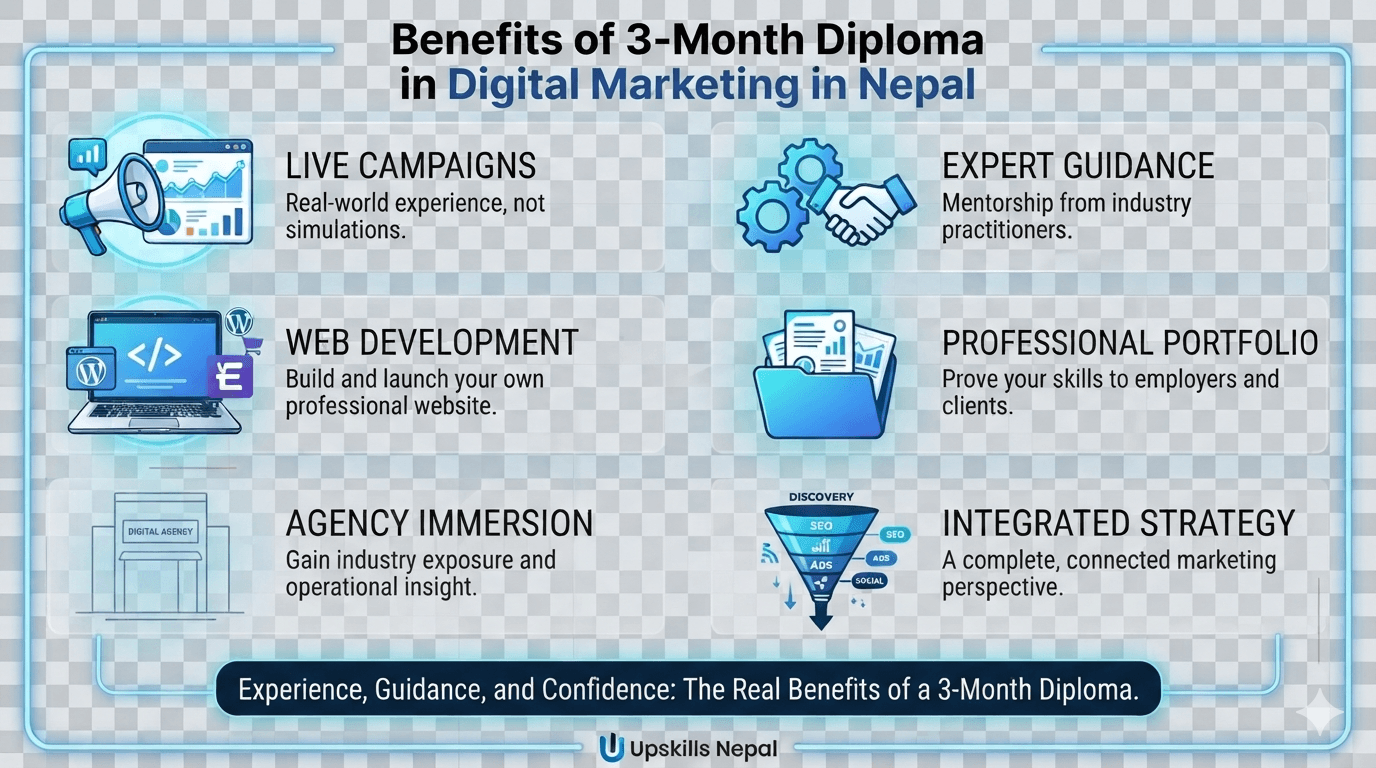
- You spend real money on real ads. During the social media weeks, students run an actual live paid campaign worth $10. Later, in the Google Ads module, they run a second one. Losing ten real dollars on a badly targeted ad, with a trainer right there explaining exactly why, teaches you something no slide deck can.
- You build a website that’s actually live. Two full weeks are set aside for this: domains, hosting, WordPress, a basic e-commerce setup. Most digital marketing training in Nepal skips this and assumes someone else handles the website. Here, you become that someone.
- You spend two days inside a real agency. Students spend two days at ClickDribble’s actual office – a working digital marketing agency, not a role-play exercise. That kind of exposure quietly tells you an institute has real industry relationships, not just claims of one.
- You learn from someone who’s actually built a career doing this. Prajwal Karki leads the diploma, with over twelve years in SEO, performance marketing, and brand strategy, and more than 10,000 students trained. What students mention most isn’t the lecture. It’s the ten minutes after class when he pulls up your actual ad account and tells you exactly what’s broken.
- You get business mentorship too. Anirup Ghimire, who runs Apstom Technologies, sits with students to talk through real business ideas- useful if freelancing or starting something of your own is on your mind.
- You leave with a portfolio, not just paper. A certificate proves you attended. It says nothing about whether you can do the work. You’ll walk away with SEO audits, live ad campaigns, a website you built yourself, and analytics reports: real things you can put in front of an employer and say, I did this.
- You start seeing how the pieces connect. A customer discovers your business through a Google search, sees your Facebook ad a few days later, then gets an email with a small discount that finally gets them to buy. Every channel supports the others. Once you see that whole journey clearly, you stop thinking like someone who only knows one platform.
Put together, this is what the benefits of a 3-month digital marketing diploma look like- the kind that shows up months later in how confidently someone handles an actual campaign, not on the certificate itself.
Full Diploma Syllabus: What You’ll Learn in 12 Weeks
Unlike short-term workshops that focus on individual topics, this 12-week diploma syllabus follows a structured learning path. Each module builds on the previous one, combining theory with hands-on projects, live campaigns, and industry-standard tools.
Week | Module | Skills & Learning Outcomes |
Week 1 | Digital Marketing Fundamentals | Understanding digital marketing, branding, customer journeys, and the RASPE framework |
Week 2 | Content Marketing | Creating SEO-friendly blogs, social media content, and content strategies that engage the right audience |
Week 3 | Social Media Marketing | Organic strategy, Meta Ads, influencer marketing, and your first live Meta Ads campaign |
Weeks 4–5 | Website Development | Building and publishing a live WordPress website — domains, hosting, responsive pages, basic e-commerce |
Weeks 6–7 | Search Engine Optimization | Keyword research, on-page, off-page, technical and local SEO, plus Schema, AEO, and GEO applied to a real website |
Weeks 8–9 | Search Engine Marketing | Planning, launching, and optimizing a live Google Ads campaign with real conversion tracking |
Week 10 | Email Marketing & Automation | Automated campaigns, lead nurturing, and audience segmentation using Mailchimp |
Week 11 | Data Analytics & AI | Google Analytics 4, Tag Manager, Search Console, Looker Studio, Hotjar, Clarity, and AI-assisted decision-making |
Week 12 | Career Preparation & Capstone | A real-world capstone project, portfolio building, CV prep, freelancing basics, and career support |
Practical Learning Beyond the Classroom
Throughout the diploma, you’ll also launch live Meta Ads and Google Ads campaigns with real budgets, build and optimize your own WordPress website from scratch, apply SEO techniques to improve a real website’s rankings, and gain agency exposure through ClickDribble. By the end of these 12 weeks, you’ll have more than a certificate- a portfolio of real projects and the confidence to pursue a career, freelance, or grow your own business.
Why These Skills Matter Right Now
According to DataReportal’s Digital 2026: Nepal report, the country had roughly 16.6 million internet users and 14.8 million social media users by late 2025. As more Nepali businesses build out their online presence to reach that audience, professionals with real, practical skills in SEO, paid advertising, and content marketing are becoming genuinely valuable, not just nice to have on a CV.
Tools You’ll Actually Get Your Hands On
Google Ads, Google Analytics, Search Console, SEMrush, Ahrefs, Meta Business Suite, Meta Ads, WordPress, Hotjar, Microsoft Clarity, MailChimp, and yes, ChatGPT and Claude too, because pretending AI isn’t part of a marketer’s daily toolkit in 2026 would be dishonest.
If you’re weighing this against the 1-month advanced training, the difference is this depth- the shorter course assumes you’re already comfortable with the fundamentals. This diploma doesn’t assume anything. It builds you up from the ground.
Why Your Portfolio Matters More Than Your Certificate
Picture two graduates applying for the same digital marketing job in Kathmandu. Both hold the same certificate. The first one hands it over and waits. The second opens a laptop, a personal website they built, an SEO case study with real before-and-after rankings, a Google Ads campaign run on a small real budget, an analytics report they can explain line by line.
Who gets the callback? For almost every employer I’ve spoken with, it isn’t close. A portfolio proves what you can do. A certificate only proves you showed up.
Who Should Join a Diploma, and Who Should Honestly Wait
Not everyone needs this particular program, and I’d rather say so now than have you discover it halfway through week six, frustrated and out of pocket.
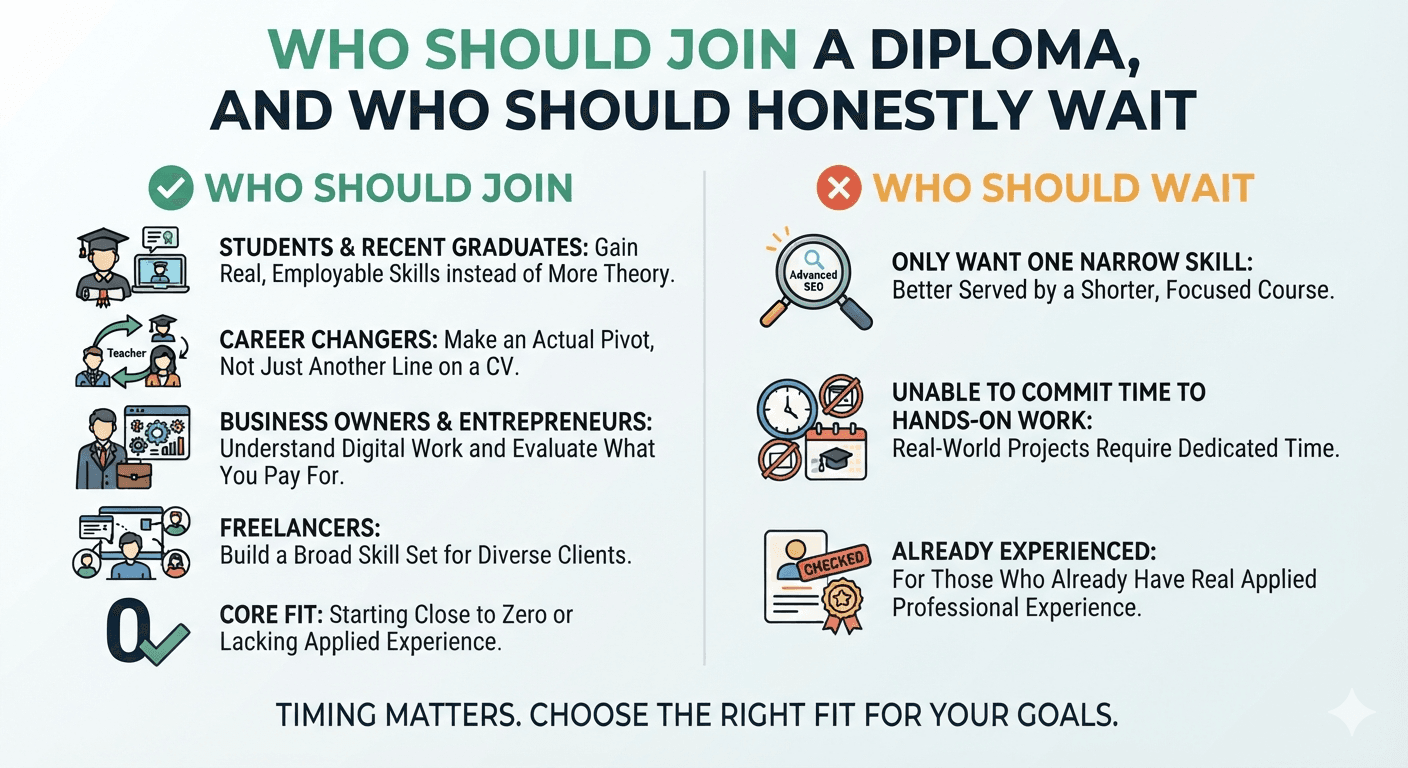
- Students and recent graduates– probably the clearest fit of all. If you’ve just finished a BBA and you’re staring down an uncertain next step, this gives you real, employable skills instead of more theory. Anushka’s journey from BBA to digital marketing is a good example of what that path can actually look like.
- Career changers: people leaving banking, hospitality, teaching, or customer service who want an actual pivot, not just another line on a CV that doesn’t change what they’re capable of.
- Business owners and entrepreneurs– tired of paying an agency for work you can’t properly evaluate. Even if you outsource afterward, at least you’ll know what you’re paying for.
- Freelancers– building a broad enough skill set to serve local and international clients without constantly outsourcing pieces of the work.
So who should join a diploma, really? One honest question: are you starting close to zero, or do you already have real, applied professional experience? This program is built for the former.
Who should wait?
If you only want one narrow skill such as advanced SEO alone, say- a shorter, focused course fits better. And if you genuinely can’t commit real time to hands-on work- actual ad spend, an actual website, an actual capstone: this format might be more than you’re ready for right now. That’s fine. Timing matters as much as ambition does.
How to Choose the Right Digital Marketing Diploma in Nepal
There’s no shortage of institutes offering digital marketing training in Nepal, and most of their advertisements start sounding the same after a while. So don’t compare the advertisements- compare the actual learning experience underneath them.
- Ask whether the syllabus is genuinely current, or whether it reads like something written five years ago.
- Ask whether students complete real projects with real ad spend, or whether everything is simulated.
- Ask whether the trainers are named and findable on LinkedIn, or just “years of experience” with nothing to check.
- Ask whether there’s genuine career support once the course ends. And ask whether you can verify the institute’s reputation independently- real reviews, real former students, a real physical address.
If an institute hesitates on any of these, that tells you more than their glossiest brochure ever will.
3-Month Diploma vs Other Digital Marketing Training in Nepal
Feature | 3-Month Diploma | Short Workshop | Self-Learning |
Learning depth | Comprehensive | Basic | Depends on you |
Real ad spend | Yes- live $10 campaigns | Rarely | Self-funded, unguided |
Website building | Included, hands-on | Often missing | Self-taught |
Mentor feedback | Regular, personal | Limited | None |
Portfolio built | Yes, including capstone | Rare | Self-managed |
Career support | Job fair + 15+ partners | Varies | None |
Best for | Beginners, career changers | Quick skill top-ups | Independent learners |
Short courses aren’t a bad choice for everyone- if you already understand marketing and want to sharpen one skill, they work well. Free tutorials are genuinely useful too. The real problem with going it alone is structure: without a clear order, beginners jump between SEO, social, and ads without seeing how they connect. That’s the gap this diploma syllabus closes.
Beyond structure, a few things set this diploma apart: real ad spend instead of simulations, two real days inside ClickDribble’s office, and outside validation- Digital Magazine Nepal ranked it among the best digital marketing courses in the country, alongside 100+ five-star Google reviews and 15+ active hiring partners.
What Can You Realistically Earn?
What you actually earn afterward depends on your practical skills, the quality of your portfolio, how well you communicate, and how much you keep learning after the diploma technically ends. Digital marketing is a skill-based field, not a credential-based one. The more real value you can demonstrate, the more doors open.
Most graduates start in entry-level roles and specialise gradually, some into SEO, some into performance marketing, some into content or email work. Others move into freelancing with international clients or eventually build their own small agency. The certificate might get you the interview. Your portfolio usually decides whether you get the job.
Career Paths After the Diploma
Digital marketing rarely locks you into one single path, which is part of what makes it appealing in the first place. Based on what this diploma actually prepares you for:
- Digital Marketing Executive is the most common starting point- supporting campaigns across SEO, social, content, and paid ads and getting broad exposure early on.
- An SEO specialist suits anyone who genuinely enjoys research, writing, and the slow, satisfying puzzle-solving of improving a website’s visibility over time.
- A social media manager is for people who like planning content, running campaigns, and actually growing a community rather than just posting into the void.
- A Google Ads or performance marketing specialist fits the more analytically minded, managing real budgets, reading conversion data, and constantly optimizing toward better numbers.
- A content marketer works well if writing and storytelling come naturally to you- blogs, landing pages, and newsletters that actually get read.
- Freelancing is an increasingly common path among Nepali digital marketers now working comfortably with both local and international clients.
- Entrepreneurship is the final path using these same skills to run your own marketing instead of outsourcing it blindly to someone you can’t properly evaluate.
For more depth on any of these, our skills required to be a digital marketer guide breaks each one down further.
5 Common Mistakes Students Make When Choosing a Diploma
- Choosing the cheapest option. A lower fee often means fewer real projects or less mentor time. Ask which course builds the strongest skills, not which costs least.
- Chasing the certificate over the skill. Most employers care more about what you can demonstrably do than what paper you’re holding.
- Skipping the practical side entirely. Before enrolling anywhere, ask directly- will I build a real website? Run real campaigns? Leave with an actual portfolio?
- Expecting overnight results. Digital marketing takes consistent practice, not a shortcut to a high salary.
- Assuming learning stops the moment the diploma ends. Google updates its algorithms, Meta changes its ad tools, AI keeps shifting the work- staying curious afterward is what keeps you relevant.
Real Alumni, Real Outcomes
This is the part most competing blog posts on this exact topic can’t back up with actual names.
Prinsa Shrestha is now a Digital Marketing Executive at Spark Group UK. Smrity Pulami holds the same title at Yellow Lotus USA. Rajul Manandhar works at Springbase.ai. Shrijana Tandukar moved into a Project Manager role at Dogma Group- a step beyond marketing execution and into leading projects outright. Sonam Sherpa chose freelancing and now works with international clients as a digital nomad. Rubina Maharjan became a Digital Marketing Executive at Renegade Insurance.
This isn’t one lucky, cherry-picked story dressed up to look like a pattern. It’s agency work, in-house roles, freelancing, and even a move into project management- real proof the same foundation carries people in genuinely different directions, depending on what each of them chose to build on top of it.
Final Verdict: Is a 3-Month Digital Marketing Diploma Worth It?
If your only goal is collecting another certificate, this probably isn’t the best use of three months. But if you want real, demonstrable skill- a portfolio with your own work in it, and the confidence to run an actual campaign without someone holding your hand- the time pays for itself.
Digital marketing isn’t a career you master sitting in a classroom. It’s one you build by doing the work, getting parts of it wrong, fixing what broke, and staying curious as the tools keep shifting. A good diploma gives you the foundation. What you build on top of it is up to you.


Very interesting subject , thankyou for putting up.