

Growth of the Digital Marketing Education in Nepal (2026 Guide)
Written by UpSkills Nepal Editorial Team
If you walk through Thamel or New Road today, you’ll see every second shop has an Instagram page now. Some have a WhatsApp number for orders. A few even sell on Daraz. Ten years ago, that same shop just had a signboard and word of mouth. That’s the whole story of digital marketing education in Nepal, really squeezed into one street.
This guide is for anyone trying to find their place in that change. Maybe you’re a fresh graduate, wondering why your degree isn’t opening doors. Maybe you own a shop, and you’re tired of watching competitors win online. Or maybe you’re mid-career and want out of a job going nowhere. We’ll cover what’s driving this growth, what training actually costs, what it pays, and how to pick a good program without wasting your money. We’ll also look at the skills employers value most today, the training options available in Nepal, and the questions you should ask before investing in any course.
Why Digital Marketing Education Is Having a Moment in Nepal
Here’s a scene that plays out all the time in Nepal. A BBA graduate finishes college, degree in hand, and sends out forty job applications. Maybe two replies. Meanwhile, a friend who did a three-month practical course- no degree, just hands-on skills, is already running social media for a local business. And getting paid for it.
That gap is real. It’s the whole reason this training sector exists. On the other side, small business owners in Patan and Lalitpur watch a competitor’s Facebook page grow while their own shop has zero online presence. They know they’re losing customers because of it. They just don’t know where to start. Both of these people land on the same conclusion, from opposite directions. Nepal’s internet economy has grown fast. The skills to use it well haven’t caught up yet.
By late 2025, about 16.6 million people in Nepal were online, around 56% of the population. Close to 14.8 million had some kind of social media account, according to DataReportal’s Digital 2026 Nepal report. That’s not a small market. That’s most of urban Nepal, and a growing slice of everywhere else too.
You’ll also see numbers from the Nepal Telecommunications Authority showing broadband use above 140%. That’s not a typo. It’s not more people than the whole country either. It happens because many Nepalis carry two or three SIM cards. The 56% figure is the more honest number- real individuals are actually online.
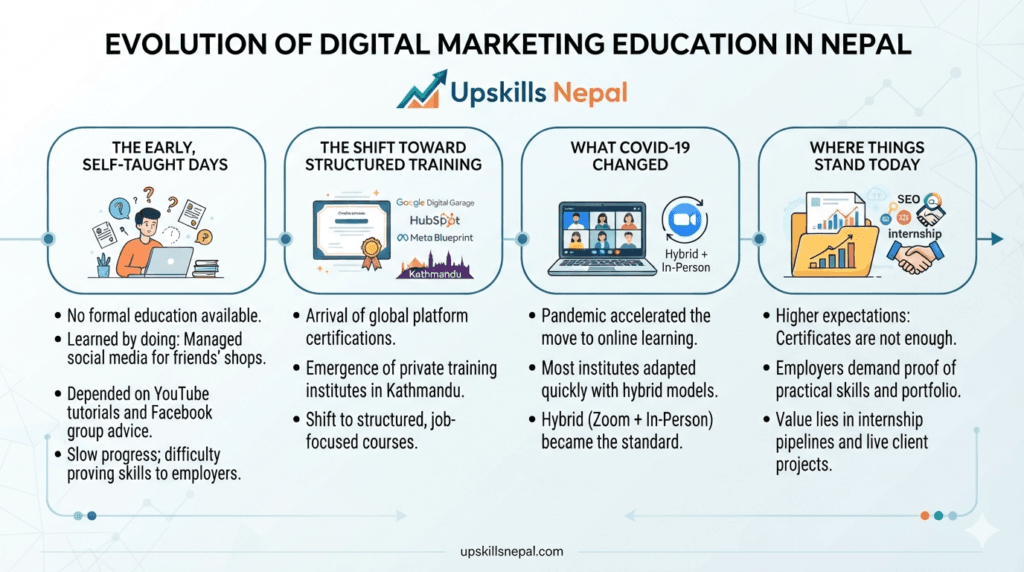
Evolution Of Digital Marketing Education in Nepal
The Early, Self-Taught Days
Go back eight or nine years, and there was no real “digital marketing education” scene in Nepal. People learn by doing. Running a Facebook page for a friend’s shop. Watching YouTube tutorials late at night. Picking up scraps of advice in Facebook groups where nobody really knew for sure either. It worked, kind of. But it was slow, and there was no way to prove your skills to an employer.
The Shift Toward Structured Training
Things changed once global platforms made real certification easy to get. Google Digital Garage. HubSpot Academy. Meta Blueprint. Suddenly, you could follow an actual course instead of guessing your way through. Around the same time, private training institutes started opening in Kathmandu. Structured, job-focused courses replaced scattered tutorials. This is really when digital marketing education became its own thing in Nepal.
What COVID-19 Changed
The pandemic sped everything up. Institutes that only taught in person had to figure out online classes almost overnight. A lot of that stuck. Most training providers in Kathmandu still run a hybrid model today- some sessions in person, some over Zoom.
Where Things Stand Today
The bar has moved higher. A certificate alone isn’t enough anymore. Employers increasingly want proof of practical skills rather than certificates alone. A portfolio showing SEO work, content writing, Google Ads campaigns, Meta advertising, or website analytics often carries more weight during interviews than a certificate by itself. That’s why internship pipelines and live client work now separate a training program worth the money from one that’s just slides and a PDF.
Types of Digital Marketing Education Nepal- Compared
Before you spend a single rupee, you must look at your options side by side. Here’s an honest breakdown. We won’t name or rank specific institutes- just the categories.
Type | Typical Duration | Typical Cost | Certification Recognition | Job/Internship Support | Best For |
University degree (BBA/BBM, marketing focus) | 3-4 years | Full degree cost varies a lot by college | Academic, not industry-specific | Usually limited, self-arranged | Students who also want a formal degree |
Private training institute (Nepal-based) | 6 weeks to 4 months | Roughly NPR 10,000-40,000+, depending on depth | Institute certificate, often paired with Google/HubSpot/Meta credentials | Often includes internship or placement help | Fastest path to job-ready skills |
Global online platforms (Google, HubSpot, Coursera) | Self-paced | Often free, some paid certificates | Globally recognized | None – fully self-directed | Adding to other training, or disciplined solo learners |
Self-taught (YouTube, blogs, trial and error) | Open-ended | Free to low cost | None | None | Early exploring before you commit |
Most people actually mix these. Someone finishes a BBA, realizes the classes barely touched real tools, then takes a private institute course to actually get hired. That mix is more common than picking just one path.
What Does Digital Marketing Education Cost in Nepal?
This is the question everyone wants a straight answer to. The honest answer: it depends on what’s actually included. A cheap course that’s just recorded videos and a PDF isn’t the same as a program with live client work, a real certification, and job support built in.
Here’s what moves the price up or down for digital education:
- Duration: a two-week crash course costs less than a four-month program, for obvious reasons.
- Certification partnerships: Programs tied to Google, HubSpot, or Meta usually cost more because that certification carries real weight.
- Live projects vs. theory only: hands-on campaign work with real budgets costs more to run than lecture-only classes.
- Placement support: Internship help and job-search support add cost, but they also add real value.
The cheapest option isn’t always bad value. The most expensive isn’t always the best. What matters is whether the price matches what you actually get. If a course can’t explain clearly what’s included, ask before you pay, not after.
Who Can Learn Digital Marketing in Nepal?
Students & Recent Graduates
Got a BBA or BBM and a job market that doesn’t seem to care? You’re not alone, and you’re not stuck either. Structured training gives you something a degree usually doesn’t: real project work you can show off in an interview, plus hands-on skill with tools employers actually expect you to know.
Young Professionals Making a Pivot
Maybe you’re in banking, or admin, or some other job that feels like a dead end. Digital marketing is one of the more realistic career pivots right now. It’s growing fast, it’s remote-friendly, and most training assumes zero marketing background. You’re not starting from behind.
Entrepreneurs & Small Business Owners
This is where the value is easiest to see. A shop or service business that starts running its own social media and basic ads- even just decently, not perfectly- usually sees a real bump in reach and customer questions. This group often gets more value from learning it themselves than from hiring an agency they can’t fully judge anyway.
Career Switchers
Digital marketing is different from many careers, as it emphasizes skill sets that are acquired through actual training and experience, rather than many years of specific education. This means that regardless of whether you work in a non-technical environment, in IT, in customer service, in banking, in education, or any other career, it is possible to have a thriving digital marketing career.
What’s Driving Demand for Digital Marketing Skills in Nepal
Youth unemployment and the skills gap. Nepal’s youth unemployment rate, ages 15 to 24, sits around 20.8%, according to World Bank estimates. That’s roughly one in five young people. The global average is closer to 15.7%. That gap between school and job-ready skills is exactly what this training sector has grown to fill.
E-commerce isn’t niche anymore. Daraz and platforms like it have made online buying normal in a way that didn’t exist ten years ago. Every business selling through them needs someone who knows how to market there properly, not just post a product and hope. The rise of AI tools, online marketplaces, and performance marketing has also increased the scope of digital marketing for those who can use platforms such as Google Analytics, Google Search Console, Meta Ads Manager, Canva, and WordPress to grow businesses online.
Remote work is paid in dollars. This is the one that gets people’s attention fast. Nepali marketers picking up clients through Upwork or Fiverr can earn in US dollars while living in Nepal. Given local living costs, that changes the math on this whole career path. It’s one of the clearest, most motivating reasons people take this seriously.
Core Skills You’ll Gain from a Digital Marketing Course
A reputable digital marketing course will equip you with practical skills rather than just giving you a certification. Though all courses are unique, some essential skills are included in almost every reputable program.
- SEO: Acquire knowledge about improving your website’s ranking on Google through keyword research, on-page optimization, and content creation.
- Content Marketing: Produce blog posts, landing pages, email, and social media marketing content to capture and engage the right target audience.
- Google Ads & Meta Ads: Acquire knowledge on campaign planning, targeting audiences, budgeting, and analyzing the performance of your advertising campaigns.
- Analytics: Apply tools like Google Analytics and Google Search Console to track website traffic and analyze results.
- Website & Design Tools: Acquire practical experience in the application of platforms like WordPress and Canva, commonly used in marketing.
- AI & Marketing Strategy: Learn how to apply AI in research, planning, and productivity development while acquiring the necessary marketing strategy skills and creativity.
The most valuable courses combine these skills with practical projects, helping you build a portfolio that demonstrates what you can do, not just what you’ve learned.
What Can You Actually Earn? Digital Marketing Salary in Nepal
Entry-level roles in digital marketing careers usually start around NPR 20,000 to 35,000. Professionals with two to three years of solid, specialized experience often cross NPR 100,000 a month. What moves you from the bottom of that range to the top isn’t just years worked. It’s whether you specialize in SEO and PPC, consistently pay more than general roles, and whether you can point to real results, not just tasks you completed.
Level | Typical Monthly Range (NPR) |
Entry-level / fresher | 20,000-40,000 |
Mid-level (2–3 years, or specialized in SEO/PPC) | 40,000-85,000 |
Senior management | 80,000-150,000+ |
Freelance, international clients | Varies a lot, often higher than local salaried jobs once you’re established |
The Bigger Picture: Digital Education in Nepal Beyond Marketing
Where Traditional Education Falls Short
Most university marketing classes are still heavy on theory. Case studies, frameworks, exam-style learning. Light on actually opening Google Ads or Meta Business Suite and running a real campaign. That’s not really the professors’ fault. Curriculum just takes longer to update than the tools themselves change.
Why Private Institutes Filled the Gap
Private, industry-led institutes grew because they could move faster than universities. They update lessons every time a platform changes its ad system. They bring in instructors who are actively working in the field right now, not teaching from a textbook written five years ago.
How to Select an Ideal Digital Marketing Program
With so many digital marketing courses available, it’s worth taking a few minutes to compare what each one actually offers. A good digital marketing course should do more than help you earn a certificate. By the end of the program, you should know how to plan campaigns, understand customer behavior, measure results, and use the same tools many businesses rely on every day.
Here are some questions that you must ask before joining any such program:
- Is it certified by any reliable institution? Ensure that the certificate comes either from the institute itself or from a platform like Google, HubSpot, or Meta.
- Would it help me gain practical experience? Good programs are the ones that include live projects, case studies, and assignments rather than just theoretical knowledge.
- Is career assistance provided? See if the institute provides any internships or placements after training.
- Who teaches you? Learning from experts in the field can help you get valuable insights rather than just bookish knowledge.
- Is it worth the money? The fees, mentoring, learning resources and certifications must be in proportion with each other.
Taking the time to compare programs before enrolling can save both time and money. A course should help you build practical skills, a professional portfolio, and the confidence to work with real clients-not simply provide another certificate.
Real Learner Stories
One of the best ways to evaluate a digital marketing course is to look at the success of its graduates. UpSkills Nepal shares verified learner stories that show how practical training, hands-on projects, and industry mentorship have helped learners build careers in digital marketing.
Sonam Sherpa: From Career Change to Digital Marketing Specialist
Sonam Sherpa was able to obtain his first internship within a month of joining the program. He went on to work with several clients, moved into consulting, and established himself as a digital marketing specialist. The culmination of his professional life was the delivery of international digital marketing training.
Anushka Bajracharya: Growing a Career in Digital Marketing
Anushka Bajracharya made her way into the digital marketing field following her training. She started as a digital marketing officer and advanced to become a digital marketing executive at Omnicom Media Group Nepal, where she handles the areas of SEO, content creation, social media marketing, and digital campaigns.
UpSkills Nepal also highlights alumni working with organizations such as Spark Group UK, Yellow Lotus USA, Springbase.ai, Dogma Group, and Renegade Insurance, while others have built freelance careers. Together, these stories provide prospective learners with real examples of career progression and the opportunities that practical digital marketing training can create.
Why Practical Training Matters
Throughout this guide, one point has remained consistent: practical experience matters. Understanding marketing concepts is important, but applying them through real projects is what helps learners become job-ready.
UpSkills Nepal follows this approach by combining hands-on learning, industry mentorship, recognized certifications, and career support. Whether your goal is employment, freelancing, or growing your own business, the focus is on building practical skills and a portfolio that can support your next step.
The Bottom Line
Digital marketing education in Nepal has grown because businesses need practical skills that traditional education alone often doesn’t provide. Whether you’re a recent graduate, a professional planning a career change, or a business owner looking to grow online, learning digital marketing can open new opportunities, but the quality of your training matters.
Choose a program that emphasizes practical projects, experienced mentors, recognized certifications, and career support. The right course won’t simply teach you digital marketing; it will help you build the confidence and portfolio needed to apply those skills in the real world.
Ready to Learn Digital Marketing?
Whether you’re a student, job seeker, freelancer, entrepreneur, or working professional, learning digital marketing can open new career and business opportunities.
Explore practical training for digital marketing in Nepal featuring hands-on projects, AI-powered tools, portfolio development, and expert guidance.
View the Course & Upcoming Batches
FAQs
Is digital marketing education worth it in Nepal in 2026?
For most people entering the job market or trying to grow a business online, yes. The gap between demand for these skills and the number of people who actually have them is still wide. That keeps both jobs and freelance income as realistic goals.
How much does digital marketing education cost in Nepal?
It ranges a lot- roughly NPR 20,000 to 30,000+ for most private institute programs, depending on length; whether it includes a global certification, and whether job support is included. University degrees cost much more but aren’t focused specifically on digital marketing skills.
What salary can I expect after learning digital marketing in Nepal?
Entry-level roles usually start around NPR 20,000-40,000 a month. With two to three years of experience, especially in SEO or PPC, NPR 80,000–100,000+ becomes realistic.
How has digital marketing education evolved in Nepal?
It moved from informal, self-taught learning through YouTube and Facebook groups to structured, certified training through global platforms and private institutes. COVID-19 sped this shift up a lot, pushing hybrid and online learning into the mainstream.
Do I need a business degree before studying digital marketing?
No. Most structured programs assume no prior marketing background at all. They’re built for complete beginners.
Can digital marketing skills help me work remotely for foreign clients?
Yes. This is one of the more realistic remote-income paths available in Nepal right now. Skilled freelancers earn foreign currency through platforms like Upwork and Fiverr.
Reviewed & Validated By:
Prajwal Karki – Digital Marketing Strategist and Trainer at UpSkills Nepal


