
Why You Should Start a Digital Marketing Career in Nepal
Written by UpSkills Nepal Editorial Team
Six months ago, I watched two BBA graduates take completely different paths. One kept applying for “proper” corporate jobs and sat unemployed for four months, refreshing job portals every morning like it was a religion. The other spent that same stretch learning Facebook Ads and basic SEO, and by month three, she was billing three small clients from her room in Baneshwor. Same degree, same city, same year. Two totally different outcomes.
That gap is exactly why so many young Nepalis are now seriously asking one question: is building a digital marketing career in Nepal actually worth it, or is it just another trend everyone’s shouting about?
Short answer: Yes. The long answer, with real numbers and a few uncomfortable truths, is below.
Is a Digital Marketing Career in Nepal Worth It?
Nepal’s internet reach has crossed 90% of the population, according to Nepal Telecommunications Authority data, and roughly two out of three people here are active on social media. Businesses already know their customers are online. What they don’t have enough of is people who actually know how to reach them there properly.
That gap is your opening. This digital marketing career in Nepal doesn’t demand an expensive degree, doesn’t require leaving the country, and, unlike most paths open to young Nepalis right now- pays you something while you’re still learning. It’s not a fairy tale. It’s just supply and demand, and right now, demand is winning by a wide margin.
Reason 1: Nepal Has More Online Businesses Than People Who Can Run Them
Walk through Patan or New Baneshwor and count how many shops have an Instagram page. Nearly all of them, right? Now count how many are actually managed well: a real content plan, captions that don’t look copy-pasted, and ads that convert instead of just sitting there. Barely a handful. That mismatch, in one sentence, is the whole opportunity.
Nepal moved past “should we go online” years ago. Banks run app-download campaigns during the festival season. Trekking companies fight over the same Google searches tourists type in from Delhi, London, or Sydney. E-commerce sellers- Daraz Nepal, SastoDeal, and hundreds of Instagram-only boutiques- compete daily for the same limited attention span. Every single one of them needs someone who understands SEO, paid ads, content, or email marketing. There simply aren’t enough trained people to go around yet, and that’s not going to change overnight.
That’s not motivational talk. That’s just what happens when internet growth outruns the supply of skilled workers.
Where the Jobs Actually Sit
Kathmandu, Lalitpur, and Bhaktapur remain the hub: most agencies, banks, and multinational offices sit here, which is exactly why training centers cluster around areas like Putalisadak. Pokhara is catching up fast too, mostly pushed by hotels, travel agencies, and restaurants that finally understand a Facebook page alone doesn’t fill rooms or tables. Even smaller cities like Biratnagar and Butwal are starting to see local businesses hire their first “social media person,” even if the job title itself hasn’t quite caught up yet.
Reason 2: Career Opportunities Go Far Beyond “Marketing Agencies”
Students assume digital marketing career in Nepal in this field begin and end at ad agencies. That’s simply not true anymore, and clinging to that idea limits where you even bother applying.
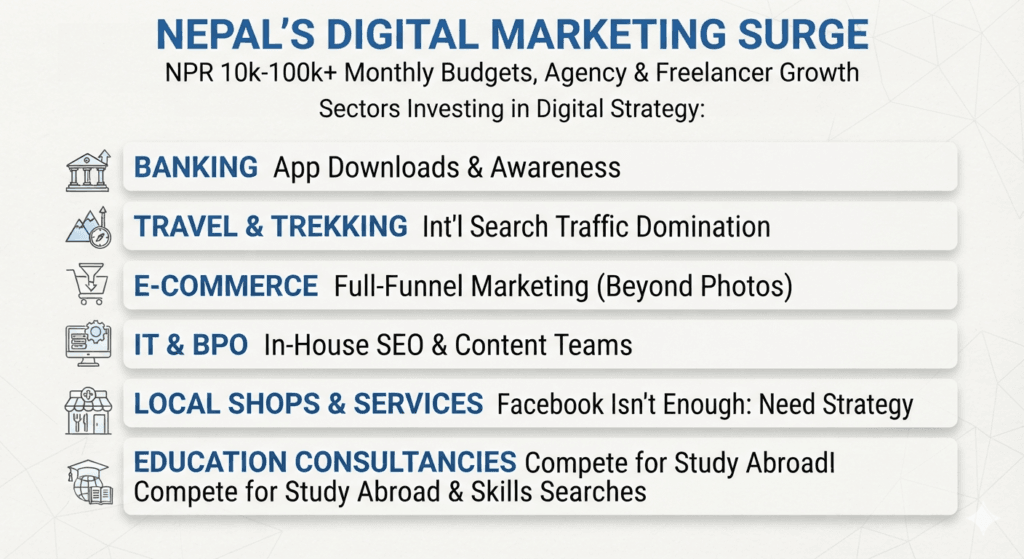
Nepali businesses now spend anywhere from NPR 10,000 to well over NPR 100,000 a month on digital marketing, depending on scope and whether they hire an agency or a solo freelancer. That’s real budget, spread across sectors people don’t usually expect:
- Banks and financial companies running awareness and app-download campaigns
- Travel and trekking companies are competing hard for international search traffic
- E-commerce startups need full-funnel marketers, not just people who post pictures
- IT and BPO firms are building in-house content and SEO teams instead of outsourcing everything
- Local shops, clinics, restaurants: the ones finally realising that a Facebook page alone sells nothing on its own
- Education consultancies and training institutes compete for the same “study abroad” and “learn skills” searches every intake season
This is the real strength behind career opportunities here: you’re not boxed into one industry for life. Pick a sector you actually enjoy- food, travel, finance, education, fashion, and build your marketing career inside it instead of forcing yourself into generic agency work you don’t care about. For a live sense of what’s currently open, listings under Jobs in Nepal now show SEO and social roles scattered across almost every industry category, not filed under “marketing” alone anymore.
Reason 3: You Don’t Need a Marketing Degree to Start
This might be the single biggest reason career switchers keep flooding into this field. Unlike banking, engineering, or medicine, nobody checks your transcript before hiring you as a junior SEO executive. Nobody asks which college your certificate came from either.
What actually gets checked is your portfolio. Did you help a website climb a few ranking positions? Grow a social page’s real followers, not bought ones that vanish after a week? Run even one small ad campaign with your own pocket money and track what happens.
I’ve trained SEE-pass students, +2 graduates, BBA holders, and even a former civil engineer who switched into this field in months, not years. None of them had a marketing certificate walking in the door. What they had eventually, after some effort, was proof of work.
That doesn’t mean training is useless. Far from it, actually, because bad SEO habits picked up from random YouTube tutorials waste months you don’t get back later. A good instructor catches those mistakes before they become expensive. But the entry barrier itself? Low. Refreshingly low, compared to almost anything else open to a fresh graduate in Nepal right now.
Reason 4: Entry-Level Marketing Jobs Pay You While You’re Still Learning
Let’s talk numbers, because vague promises don’t pay rent in Kathmandu.
Internship stage: Most digital marketing internships here pay somewhere between NPR 5,000 and 15,000 a month. Some are unpaid, especially at smaller agencies; treat that stretch as tuition you’re earning instead of paying, because the case studies you leave with matter more than the stipend itself.
First hire, zero experience: Entry-level marketing jobs typically start around NPR 18,000 to 35,000 a month. Specialized entry roles, like a junior PPC assistant, can start a bit higher, closer to NPR 25,000 to 40,000.
Six to twelve months in, with a portfolio: This is where things get interesting. A handful of documented results, even something as simple as “grew a client’s Instagram from 800 to 4,000 followers in four months,” push pay up to NPR 25,000 to 60,000 a month.
Here’s a rough breakdown of what entry-level marketing jobs commonly pay by role, based on aggregated Nepal job market data:
Role | Typical Starting Pay (NPR/month) |
Social Media Executive | 20,000- 30,000 |
SEO Assistant | 20,000- 30,000 |
Content Writer / Marketer | 20,000-30,000 |
PPC / Ads Assistant | 25,000- 40,000 |
Email Marketing Assistant | 20,000-30,000 |
I’ve watched this pattern repeat across cohorts: a student starts as an unpaid social media intern, moves to a paid SEO assistant role within four months, and crosses NPR 40,000 before their first year is up. Nothing dramatic happens overnight. They just specialize early instead of staying a generalist, and they document every single campaign they touch, even the small ones.
Reason 5: Career Growth Has No Real Ceiling in This Field
This is where digital marketing quietly beats a lot of “safer” paths available in Nepal today.
Mid-level, two to three years in: NPR 40,000 to 100,000 a month, depending on specialization. SEO specialists handling multiple websites, or PPC specialists who can prove ROI in hard numbers, sit toward the top end of that range.
Senior and management roles: NPR 80,000 to 150,000+ a month are common. Digital marketing managers in Kathmandu are reported to average somewhere around NPR 86,900 to 110,000 monthly across aggregated salary surveys, and with bonuses added in, senior professionals can cross NPR 200,000.
The freelance route, and honestly, most guides underplay this part badly: Nepali marketers working with clients on Upwork or Fiverr, paid in USD while living on NPR expenses, often earn two to five times what the same skill would fetch locally. A marketer sitting in Pokhara serving a UK-based client isn’t capped by Pokhara’s local rates at all. Not even close.
Career growth in this field doesn’t move in neat yearly increments, the way a bank job usually does. It usually jumps right after you specialize, build a real portfolio, or land your first international client. That kind of career growth, tied directly to skill instead of seniority alone, is rare to find elsewhere in Nepal’s job market.
Reason 6: This Field Is Built for Where Work Is Actually Heading
AI tools are already reshaping how campaigns are run with automated ad bidding, AI-assisted first drafts, predictive analytics on customer behavior, and chatbots handling first-line customer queries. Some people see this as a threat to job security. I’d argue it’s the opposite if you’re starting now.
You’re not unlearning fifteen years of old habits the way a senior marketer might have to. You’re picking up strategy and tools at the same time, from day one. Professionals who treat AI as a speed tool, not a replacement for judgment, are the ones staying ahead as hiring language keeps shifting toward automation, voice search, and short-form video. That shift is already visible if you compare job postings from two years ago with what’s being advertised now.
A Day in the Life: What This Job Actually Looks Like
Most students imagine digital marketing as scrolling Instagram all day and calling it “work.” The reality is a bit less glamorous and, honestly, more interesting.
A typical morning might start with checking overnight ad performance did that Meta campaign for a Thamel restaurant client spend its budget efficiently, or did it burn money on the wrong audience? Then comes content planning, maybe drafting a blog post or fixing broken links on a client’s website that Google Search Console flagged. Afternoons often mean client calls, explaining in plain language why last week’s post didn’t perform and what’s changing this week.
It’s part creative, part analytical, and part detective work, figuring out why something worked or why it flopped using the actual data instead of guessing. That mix is exactly why some people love this career, and others find it exhausting. Better to know which one you are before you commit two years of your life to it.
Reason 7: You Can Build This Career Around Your Life
A typical office job in Nepal means fixed hours, a physical desk, and very little room to move if family needs pull you elsewhere. Digital marketing doesn’t force that trade-off on you the same way.
Remote work is normal here now. Freelancing while studying is normal. Running client work on weekends while holding a separate day job during the week is also completely normal; I know professionals doing exactly this, quietly managing two or three small accounts alongside a regular 9-to-5, earning a second income without anyone at their main job even knowing.
Want the fuller, long-term picture: job titles, industries, and growth timelines mapped out properly? Our detailed breakdown of the scope of digital marketing in Nepal covers that in depth.
Popular Digital Marketing Job Titles You’ll See in Nepal
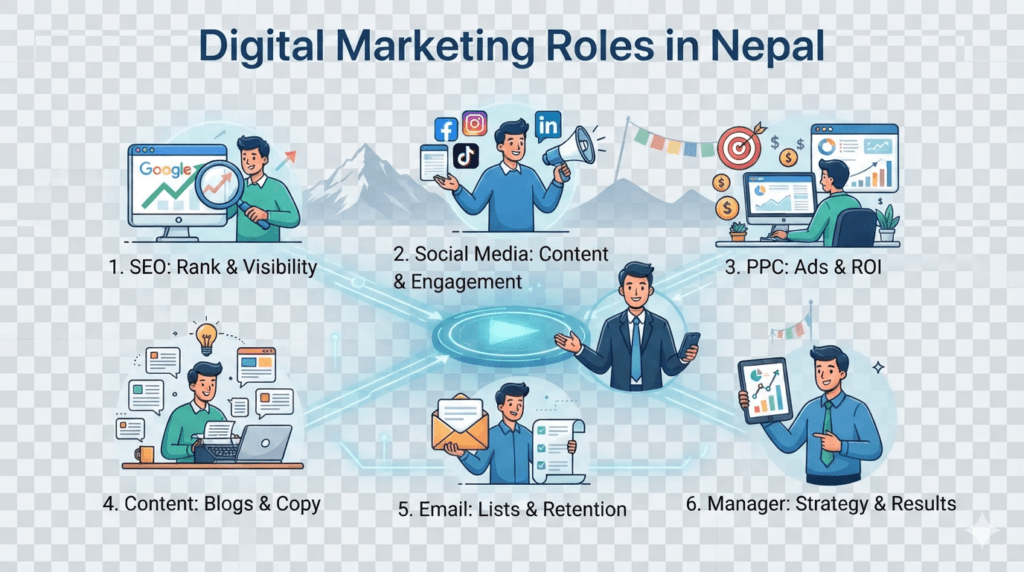
Job titles here can be confusing since companies name roles differently. Here’s roughly what each one actually does:
- SEO Specialist: improves how a website ranks on Google, using keyword research, on-page fixes, and backlinks
- Social Media Manager: plans and posts content across Facebook, Instagram, TikTok, and LinkedIn, and handles community replies
- PPC / Google Ads Specialist: runs and optimises paid ad campaigns on Google and Meta platforms
- Content Marketer / Writer: writes blogs, website copy, and captions built around what people are actually searching for
- Email Marketing Specialist: builds email lists and campaigns that keep past customers coming back
- Digital Marketing Manager: oversees all of the above, sets strategy, and reports results to leadership
Knowing these titles helps when you’re job hunting, too- a listing for “Digital Marketing Executive” could mean any mix of the above, so always read the actual job description, not just the title.
Tools You’ll Actually Use on the Job
Nobody hands you a fancy toolkit on day one. Most beginners in Nepal start with a fairly simple stack:
- Canva for quick graphics and social posts
- Meta Business Suite for scheduling and managing Facebook and Instagram
- Google Analytics and Google Search Console for tracking website traffic and fixing SEO issues
- Google Ads and Meta Ads Manager for running paid campaigns
- Basic keyword research tools to understand what people are actually typing into Google
You don’t need to master all of these before applying anywhere. Most employers expect you to know one or two well and learn the rest on the job. Trying to learn everything at once, before applying anywhere, is actually one of the more common ways beginners delay themselves for no good reason.
Is This Career Right for You? A Quick Honest Check
Before jumping in, ask yourself a few things. Nobody else is going to ask you these, so I will.
- Do you actually enjoy writing, designing, or explaining ideas, even a little?
- Are you okay reading numbers and adjusting your approach instead of guessing and hoping?
- Can you sit through two or three slow months before the wins start feeling real?
- Are you comfortable with a job that changes every few months as platforms and algorithms shift?
If yes, you’ll likely take to this field quickly. Answered no to most? Fair enough- better to know that now than after six unpaid internship months spent finding out the hard way.
Common Mistakes Beginners Make Here
I’ve watched the same mistakes repeat, batch after batch of students, almost like clockwork.
- Collecting certificates instead of building proof. A certificate says you sat through a course. A case study says you can actually do the job. Employers here increasingly want the second one, not the first.
- Staying a generalist too long. Trying to be “okay” at everything- SEO, ads, content, email caps your pay faster than picking one lane and going deep. Specialists earn more, consistently, across nearly every salary dataset available on this.
- Weak written English. This one stings, but it’s true. A large share of the better-paying freelance and remote clients expect confident written English. Skipping this quietly locks you out of the best-paying work available in this field.
Fearing freelancing. Plenty of capable Nepali marketers never try Upwork or Fiverr because it feels intimidating or unfamiliar. The ones who push through that discomfort tend to be the ones earning in dollars within a year or two.
Ignoring analytics. Some beginners treat numbers as someone else’s job. That’s a mistake- clients pay for results, and results live inside Google Analytics, not inside how nice a post looks.
How to Actually Start
Here’s the roadmap, stripped of fluff.
- Learn the fundamentals properly: SEO basics, social media strategy, Google Analytics, and one paid ads platform (Meta or Google Ads).
- Build two or three real portfolio pieces, even for free, even for a friend’s small shop. One documented result beats a diploma every single time.
- Take an internship or one small freelance project. This is where theory finally turns into muscle memory.
- Pick a specialization within your first year: SEO, paid ads, or content, based on whatever you enjoyed most in step one.
- Start applying in parallel, not after. Don’t wait to feel “ready.” Nobody ever does, and waiting only costs you time you can’t get back.
Bringing It All Together
A digital marketing career in Nepal isn’t a shortcut: no career really is, no matter what anyone promises you on Instagram. But weigh it honestly against what’s actually on offer elsewhere right now: long waits for government exam results, an oversaturated banking entry level, or an expensive foreign visa gamble with no real guarantee attached to it.
This field asks for something different instead: consistency, a willingness to learn in public, and patience through a slow first stretch that tests most people’s nerves. What it gives back in return is genuinely rare in Nepal’s job market: real career growth tied to your skill, not your connections, your caste, or which college logo sits on your certificate.
That BBA graduate I mentioned at the start? She eventually switched too. Six months into learning SEO and content writing, she landed a junior role at a small Kathmandu agency. She still says, half-joking, that she wishes she’d started the day her flatmate did instead of waiting around for a corporate offer that never came.
Ready to Build This the Right Way?
Reading about it only takes you so far. If you’re serious about turning this into real income, structured guidance shortens the learning curve massively and helps you dodge every mistake covered above. Our Advanced Digital Marketing Training in Nepal program is built exactly for that jump, from fundamentals to a working, real-world portfolio, step by step, with someone checking your work along the way.
FAQS
Is digital marketing a good career in Nepal in 2026?
Yes. Internet penetration has crossed 90%, and businesses across banking, travel, e-commerce, and retail are actively hiring or outsourcing marketing work. Demand is steady, and it’s still growing every year.
How much does a fresher earn in digital marketing in Nepal?
Fresh hires typically start between NPR 18,000 and 35,000 a month, with internship stipends around NPR 5,000 to 15,000. Pay usually climbs once you build a documented portfolio, often within six months to a year.
Do I need a degree to work in digital marketing?
No. Most employers here care more about your portfolio than your degree. SEE, +2, and bachelor’s graduates all enter this field successfully with the right training and real project experience behind them.
Which skill pays the most in entry-level marketing jobs in Nepal?
Technical SEO and PPC/paid ads specialists tend to out-earn generalist social media roles, since their work ties directly to measurable business revenue that clients can actually see.
Can I really work with foreign clients while living in Nepal?
Yes. Platforms like Upwork and Fiverr let Nepali marketers earn in USD while living on NPR expenses. Many report earning two to five times more through international clients than through local full-time roles.
Reviewed & Validated By:
Prajwal Karki – Digital Marketing Strategist and Trainer at UpSkills Nepal


