

Digital Marketing Trends for Businesses in Nepal That Drive Growth in 2026
Written by UpSkills Nepal Editorial Team
A shop owner on New Road messaged me last month. He wanted to know why his neighbor’s tailoring shop gets three times more calls than his. Same street. Same foot traffic. His shop even looks nicer. His neighbor has something he doesn’t: a Facebook page with 40 reviews and a two-minute video showing how a suit gets stitched, start to finish.
That’s the story of digital marketing in Nepal right now. It isn’t about who has the better product anymore. It’s about who shows up when a customer is deciding.
This shift has already happened, not something coming later. Nepal now has more than 16 million internet users, over half the country’s population, and that number keeps climbing. Run a business here, a restaurant in Pokhara, a trekking agency near Thamel, or a clothing shop in Butwal, and your customers are already online. They compare prices. They read reviews. They scroll past businesses that haven’t caught up.
This article covers the digital marketing trends for businesses in Nepal that will work in 2026, why skipping them costs more than most owners think, and what a small business can start doing this week, even on a tight budget.
Nepal’s digital landscape at a glance
- Internet users: 16.6 million, 56.0% of the population, as of late 2025 (DataReportal, Digital 2026: Nepal report)
- Social media users: 14.8 million identities, about 50% of the population (DataReportal)
- Facebook: still the country’s single most-used platform
- Internet access: mostly through smartphones, not computers
What Digital Marketing Really Means for a Nepali Business
Digital marketing trends for buisnessess in Nepal simply means using the internet to put your business in front of people who already want what you sell.
Old-style advertising doesn’t work that way. A newspaper ad or a hoarding board on Prithvi Highway reaches anyone who walks or drives past, and most of them don’t want what you’re selling that day. A Google search ad reaches someone who typed “momo delivery near me” ten seconds ago. One is a guess. The other is a conversation with someone who has already raised their hand.
Three shifts made this possible here. Internet access got cheap first. NTC and Ncell kept undercutting each other on data prices, so home WiFi is now common even outside Kathmandu Valley. Then smartphones took over entirely. Most people in Nepal go online through a phone, not a desktop. A website that looks broken on a small screen loses customers before they’ve even seen the product.
The third shift is the one owners underestimate most: trust moved online. People used to buy because a friend recommended a shop. Now they scroll the comment section first. They check Google reviews before walking into a restaurant. Daraz Nepal, SastoDeal, and HamroBazar taught a whole generation of Nepali shoppers to expect this kind of openness, and now they expect it everywhere, not just on the big marketplaces.
Ten years ago, your reputation lived in word-of-mouth within a neighborhood. Today, it lives in a public comment thread that anyone can read before meeting you. One ignored complaint sitting on a page for months does real damage. A handful of thoughtful replies does more good than most owners give it credit for.
Here’s the shift in plain terms:
Traditional Marketing | Digital Marketing |
Newspaper ad | Google Search / SEO |
Radio spot | Facebook & Instagram Ads |
Hoarding board | Social media content |
Flyers | Email & WhatsApp messages |
Hard to measure results | Clear, trackable analytics |
One-way message | Two-way conversation with customers |
How Nepali Customers Shop and Search Today
Watch how someone in Kathmandu finds a plumber, a bakery, and a driving school. Nobody opens a phone book anymore. They open Google, then scroll through Facebook comments to check if someone complained. Miss that first search result, or sit at zero reviews, and you’ve lost the sale. The customer never even called.
Why Trends Matter for Growth
Most owners treat digital marketing trends for buisnessess in Nepal as optional extras, something for “later.” But a trend just points to where customer attention has already moved. Ignore it long enough, and you haven’t skipped a fad. You’ve gone invisible.
A trekking company near Lakeside in Pokhara went from almost zero international bookings to a steady stream of inquiries from the US and Australia. Nothing about the actual treks changed. What changed: consistent SEO and short videos behind their listings. Now when someone searches “Annapurna Base Camp trek cost,” they show up.
That’s the value of following trends, not novelty for its own sake, but staying where buying decisions happen. Following online marketing trends Nepal is one of the more honest shortcuts to business growth in a market moving this fast. Small budgets don’t have to lose here either. A well-run Facebook ad with NPR 10,000 can outperform a much bigger, poorly targeted one. Digital marketing, done properly, remains one of the fairer playing fields left.
A handicraft workshop in Bhaktapur tells a similar story, from a different angle. The owner spent years selling wood carvings only to tourists who happened to wander into the shop during peak season. Off-season, revenue nearly stopped. After she started photographing each piece properly and listing them on Instagram and a small online store, buyers from Europe started placing orders year-round, not just during trekking season. The craft didn’t change. The visibility did. That’s what tracking a trend actually buys you: not a gimmick, but a longer selling season and customers who were always out there, just never able to find you.
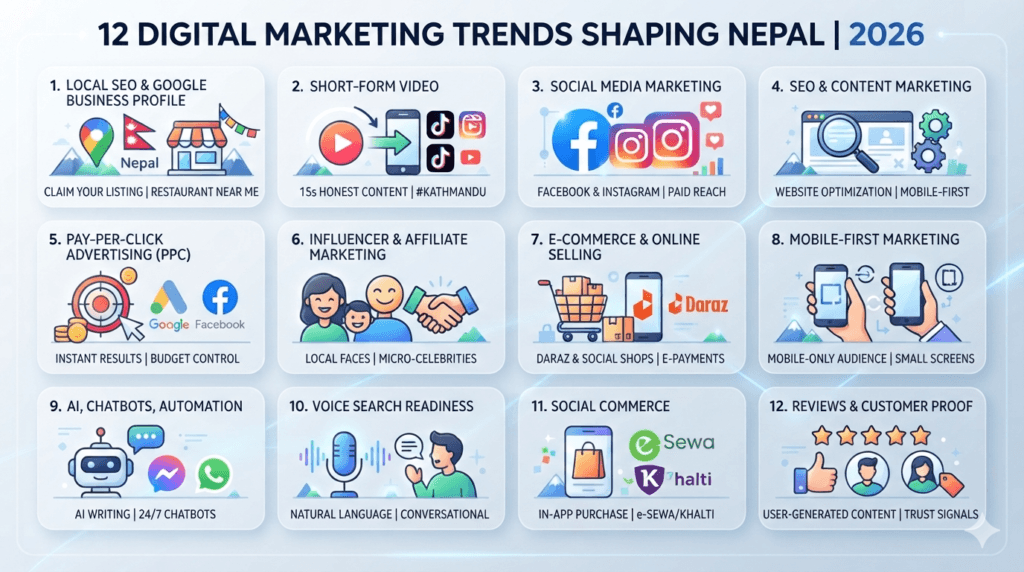
12 Digital Marketing Trends Shaping Nepal Right Now
Not trends borrowed from a global marketing blog. Each one below reflects how Nepali businesses use the internet today, and together they make up the digital marketing strategy for Nepal that’s actually working in 2026, not a copy-pasted global list.
1. Local SEO and Google Business Profile
Someone in Kathmandu types “restaurant near me.” A hardware shop’s name gets searched in Butwal. Google puts businesses with a claimed, complete Google Business Profile at the top, and it’s free. Most Nepali SMEs still haven’t set one up properly, which is good news for the ones who bother. Less competition than you’d expect.
Fill in the address, phone number, hours, and photos. Ask a handful of real customers for a review in week one. Kathmandu, Chitwan, or a town nobody outside your district has heard of- this puts you ahead of most shops on your own street.
Quick win: if you haven’t done anything else from this list today, claim your Google Business Profile. It’s free, and it’s the single fastest visibility gain available to a Nepali business right now.
2. Short-Form Video
Nobody sits through a two-minute ad anymore. Fifteen seconds, then a swipe. TikTok grew fast here and now sits beside Instagram Reels and YouTube Shorts as the format people watch to the end.
Polish isn’t what works. Honesty does. A tailor showing how he measures a suit. Steam rising off a fresh batch of momo. Simple footage like that beats an expensive production because it feels true. Post often, use trending local sounds, and tag what people search, like #Kathmandu, #Nepal, or #VisitNepal, whatever fits.
3. Social Media Marketing
Facebook still dominates in Nepal, with roughly 13 million active users. Skip a complete page there, and you’re skipping the one place almost every customer spends time.
Instagram suits anything visual: food, fashion, and tourism. A Pokhara hotel with strong lake-view photos beats one with stock images every time. But organic reach on Facebook business pages has dropped below 10% now. Even a small paid budget, NPR 5,000 to 10,000 a month, changes how many people actually see a post. Free content builds personality. Paid reach gets you seen.
4. SEO and Content Marketing
SEO brings your website to the top when people search for what you offer. Blog posts and FAQ posts answering genuine questions establish trust long before the client calls.
One thing to note about SEO is that it focuses not only on content but also on the speed of a website and whether it is mobile-friendly. Google prioritizes the speed and mobile-friendliness of sites now more than ever. It is critical to optimize your site to make sure that it takes less than 3-4 seconds to load before putting out your content. This process, however, might take up to 3-6 months, after which your traffic will begin to grow exponentially for free.
5. Pay-per-click advertising (PPC)
The benefit of PPC is that you only pay for what you get: clicks. Google Ads and Facebook Ads seem to be the best options for businesses in Nepal, as they begin to show results in a matter of days, making these marketing options ideal for short-term goals. It is essential to begin with a low budget and invest in ads that begin to bring in clients. It is also crucial to remember to measure clicks and engagement on various platforms; however, it is the conversions, not engagement, that should be prioritized and invested in.
6. Influencer and Affiliate marketing
When it comes to marketing in Nepal, a known face is way more preferable than a business account. The market for clothes, cosmetics, and food was one of the first to realize the potential reach and power of micro-celebrities. It is advisable to work with local influencers who have around 20K real followers rather than go for an unknown celebrity with hundreds of thousands of fake followers. It is essential to note that in Nepal, local is much better than national and international.
7. E-commerce and Online Selling
More Nepalis buy online than ever, through Daraz Nepal, SastoDeal, HamroBazar, or increasingly straight through social media. A handicraft business in Lalitpur, a clothing exporter, neither of them needs to rely on local foot traffic alone anymore. Buyers in the US, Australia, and the Gulf can find and pay for Nepali products through apps built for cross-border payment.
Treat the listing like a real shopfront. Clear photos, honest descriptions, fast replies. A listing left stale for months, outdated stock, unanswered questions, and losses to a competitor’s fresher one, even when the product itself is weaker, are all problems.
8. Mobile-First Marketing
Worth repeating on its own because it matters this much: most internet users here go online only through a phone. A site or ad built without mobile in mind isn’t just weaker for most of your audience; it’s the only version they’ll ever see. Check everything on a small screen before you publish, not after.
9. AI, Chatbots, and Marketing Automation
AI tools write captions and suggest content ideas now, but the useful part for Nepali businesses is simpler: chatbots on Messenger and WhatsApp answering “Are you open today?” or “What’s delivery to Lalitpur?” instantly, even at 11 pm when nobody’s at the shop.
No custom software needed. Several free or cheap tools let a one-person business set up basic automatic replies in an afternoon.
10. Voice Search Readiness
Still young here but growing. People ask their phone questions out loud now, “Find a bakery near me” or “Best momo place in Patan,” instead of typing short keywords. Voice queries tend to sound more natural and run longer than typed ones.
Write FAQs in the same conversational style people actually speak. It helps voice search and honestly makes the content easier to read either way.
11. Social Commerce
A growing number of buyers finish the entire purchase inside Facebook or Instagram now: message the page, confirm a price, and pay through eSewa or Khalti; no website visit is required. Product tags and shoppable posts are becoming a real complement to Daraz listings. Keep the process short. Every extra step between wanting something and paying for it loses customers, especially on a small phone screen.
12. Reviews and Customer Proof
A blurry photo a real customer posted, tagging your café, convinces a stranger faster than your own polished marketing shot ever will. It’s proof, not a promise, and buyers know the difference.
Ask happy customers directly for a review or a tagged photo. Most won’t bother unless asked. A short, polite request right after a good experience beats a generic “please review us” message sent days later.
What This Does for SME Marketing and Business Growth
These trends aren’t separate tricks. They compound. A business with a complete Google profile, a handful of honest reviews, and one short video a week isn’t running three campaigns. It’s building one trustworthy presence that shows up wherever a customer happens to look.
For a small or medium business here, the payoff looks like this: reach beyond the neighborhood, sometimes beyond Nepal’s borders. Costs a fraction of newspaper or radio, with results you can actually measure; you know exactly which post or ad brought in a customer, not a guess. Competing on relevance and consistency rather than budget size means a well-run small business can genuinely beat a bigger, slower one online. There’s a quieter benefit, too, the kind that never shows up on a spreadsheet. A WhatsApp thread or Messenger chat builds a familiarity that a one-off newspaper ad never could.
A restaurant answering every comment, posting one honest reel weekly, and keeping its Google profile current isn’t running three separate efforts. It’s building one presence that keeps showing up. Six months in, that consistency starts working on its own, pulling in customers who never saw a paid ad, simply because the business kept showing up.
None of this replaces a good product. A badly run restaurant with great marketing just gets bad reviews faster than it would have otherwise. What digital marketing does is it bridges the gap between having a marketable value and the possibility that it will reach the right people. In the cutthroat competition of Nepal’s small business market, those who can build trust online are seeing benefits that others who rely on cheaper strategies do not.
The Real Challenges Nepali Businesses Face
Not that it was an easy task for everyone, but digital literacy remains a challenge in Nepal, and the more competent managers often have an advantage that others do not. The lack of funds can be a serious problem for many smaller organizations, which can make it hard to advertise responsibly and, by extension, build credibility with the public. The tools required are not as inaccessible as they used to be, but the state-of-the-art internet infrastructure is still a challenge in more remote areas, and qualified workers are even harder to find outside the big cities. And there are still some consumer behaviors, often found among older or more conservative groups, that make it difficult for companies to gain popularity purely through online means.
None of this is permanent. Almost every one of these problems comes down to the same fix: someone inside the business understanding how these tools actually work, instead of depending entirely on an outside agency that may not always put your interests first.
I’ve sat with owners who burned two months of ad budget on a campaign nobody in the business could explain. No clear audience, no clear goal, just “boost the post,” week after week. That’s not really a digital marketing failure. It’s a knowledge gap dressed up as one, and it’s fixable in weeks of proper learning, not years of trial and error.
Two clothing shops opened in Biratnagar around the same time. One waited two years before setting up a Facebook page, figuring word-of-mouth was enough. The other posted from day one, answered every comment, and asked customers for reviews. By year two, the second shop had a loyal online following, pulling customers from outside the city. The first was still waiting for people to walk past. Same product quality, same price range. The only real difference was who showed up online first.
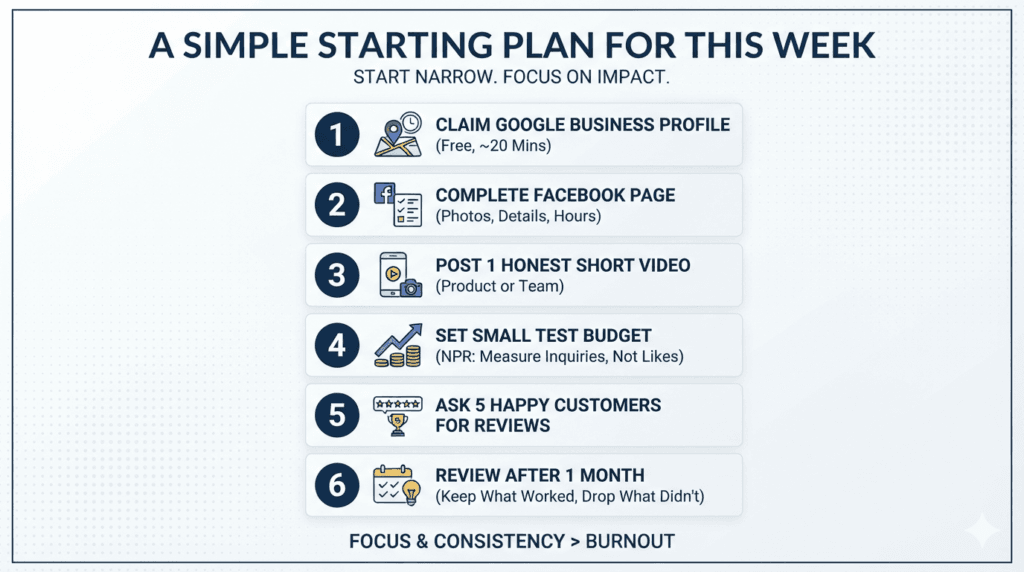
A Simple Starting Plan for This Week
Don’t run all twelve trends at once. Start narrow.
- Claim your Google Business Profile today. Free, twenty minutes.
- Complete your Facebook Business Page fully: photo, cover image, address, phone number, hours.
- Post one honest, unpolished short video this week showing your product or your team at work.
- Set a small test ad budget, NPR 5,000 to 10,000, and see what actually brings inquiries, not likes.
- Ask your next five happy customers, directly and politely, for a review.
- Check back in a month. Keep what worked. Drop what didn’t.
Most businesses that fail at digital marketing didn’t fail because the strategy was wrong. They tried everything at once, burned out in three weeks, and quietly gave up.
Why Learning the Skill Beats Outsourcing It Forever
Trends shift fast. What worked eighteen months ago, heavy reliance on free Facebook reach, barely works today. Someone in-house who understands the future of digital marketing adapts within weeks. Businesses, depending entirely on an outside agency, often find out a trend has shifted months after it has already cost them customers.
This isn’t an argument against ever hiring help. It’s an argument for having at least one person inside your business, the owner, a family member, or a staff member, who actually understands how this works. That way, you make informed decisions instead of trusting a monthly invoice blindly.
It’s also worth knowing that Google itself has said this same thing for years, long before “trends” became a buzzword. Its own Search Central guidance keeps coming back to one line: create content “for people, not for search engines.” A shop’s Facebook page, its Google profile, its blog- all of it gets judged by that same standard, whether the reader is a customer or Google’s own systems.
Ready to Build Real Digital Marketing Skills?
Learning on your own is a great start, but hands-on practice makes all the difference.
Join our Advanced Digital Marketing Training in Nepal to work on real projects, learn from experienced mentors, and gain the confidence to grow your career or freelance business. Start your journey with Upskills Nepal today.
FAQs
What are the top digital marketing trends for businesses in Nepal in 2026?
Local SEO through Google Business Profile, short videos, social commerce, AI chatbots, and steady review-building are delivering the strongest results for Nepali SMEs right now.
Which social media platform works best for a Nepali business?
Depends on your customers. Facebook has the widest reach across ages. Instagram suits visual businesses, food, fashion, and tourism. TikTok reaches younger audiences fastest, especially for product discovery.
How much should a small business in Nepal budget for digital marketing?
No fixed number, but many SMEs start well with NPR 10,000 to 20,000 a month, split between a small ad budget and steady free posting. Scale up whatever channel actually converts.
Is it worth learning digital marketing skills instead of hiring an agency?
For most SMEs, yes, at least partly. Understanding the basics lets you judge whether an agency is delivering results and react fast when a trend shifts, instead of waiting for a monthly report. Our Digital Marketing Education guide is a place to start.
How long does SEO take to show results in Nepal?
Usually three to six months for lasting traffic growth. Slower than paid ads, but it keeps bringing customers without ongoing spend once it’s working.
Can a very small business with almost no budget still use digital marketing?
Yes. A Google Business Profile and a complete Facebook page cost nothing but time, and both are often the biggest visibility gap for small Nepali businesses. Paid ads help later, but they’re not the starting point.
What mistakes should Nepali SMEs avoid in digital marketing?
The biggest ones: running ads with no clear goal, ignoring customer comments and messages, posting only promotions with no useful content, and giving up after a few weeks instead of tracking what’s working.
Reviewed & Validated By:
Prajwal Karki – Digital Marketing Strategist and Trainer at UpSkills Nepal


