
How Digital Skills For Freelancing in Nepal Are Helping Students Build Freelance Careers
Written by UpSkills Nepal Editorial Team
Digital skills for freelancing in Nepal such as writing, design, video editing, web building, virtual assistance, and digital marketing let students earn money from clients in Nepal and abroad. No plane ticket needed. No fancy office. Just a skill, a laptop, and the guts to start before you feel ready.
Key takeaways:
- Freelancing skills Nepal now reach students in Kathmandu, Pokhara, Chitwan, and small towns too, not just the big cities.
- Nepal’s mobile broadband covers about 89% of the country. A phone is often enough to begin.
- The skills that actually pay: writing, design, video editing, web building, virtual assistance, and digital marketing.
- Most online income skills take three to six months of steady work before they turn into real client money.
The Quiet Career Shift Happening on Nepal’s College Campuses
As a digital marketing trainer at Upskills Nepal, I’ve spent years watching this space grow. And I mean really watching- not skimming headlines, but sitting with students, hearing what worked and what didn’t. Here’s what I’ve noticed: something big is happening, and most people haven’t caught on yet.
A student in Kathmandu edits a logo for a shop in Sydney between two classes. A girl in Pokhara cuts video for a YouTuber she’s never met in person. A guy from a small town in the hills writes blog posts for a company based in another country entirely. None of them own fancy equipment. None of them have a business degree from abroad. They just picked one skill and stuck with it.
Ten years back, this sounded like science fiction. So why isn’t every student doing this already? Because of one bad idea that’s spread everywhere: the belief that freelancing is only for computer geeks, or people who already have five years of experience, or people whose parents bought them a MacBook. Wrong. All wrong. Freelancing doesn’t care about your background. It cares about one thing: can you solve a problem for someone who’s willing to pay for it? That’s it. That’s the whole test. A client isn’t hiring your degree. They’re hiring your result. Once that clicks, everything changes.
Why This Moment Actually Matters for Nepal
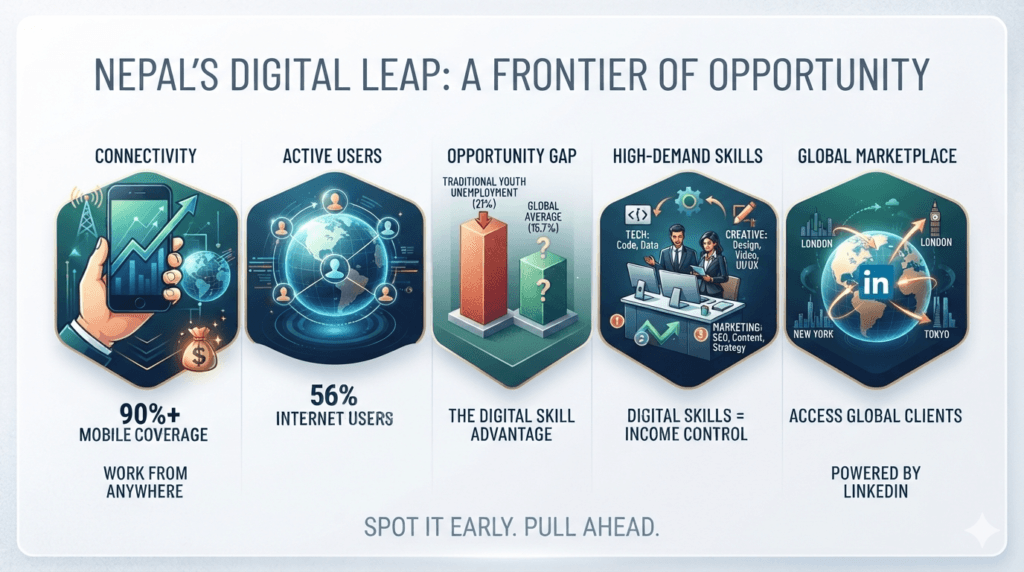
Timing matters here more than people think. Nepal’s mobile broadband reached over 90 percent of the country by late 2025. Nepal Telecom and Ncell pushed their 4G networks wider and faster than ever. That’s not a small detail, it means a phone, not a home internet line, is now enough to start earning from almost anywhere in the country. Not just Kathmandu Valley. Anywhere.
Trackers also estimate Nepal had around 56 percent of its population as active, unique internet users by early 2025. That number’s a bit lower than what telecom subscription counts show, because a lot of people carry more than one SIM card. Either way you slice it, more students are online, on faster connections, than ever before in this country’s history. Youth unemployment in Nepal has sat around 20 to 21 percent in recent years. That’s almost double the global average of roughly 15.7 percent. Read that again. Nearly one in five young people can’t find steady work through the old path.
But this same statistic is exactly why freelancing has exploded among students here. When jobs feel slow, crowded, and uncertain, one solid digital skill hands you something a degree alone can’t, control over your own schedule and your own income. Add the government’s Digital Nepal Framework into the mix, which is pushing digital access as a national goal, and you’ve got policy, infrastructure, and global demand for remote workers all pointing the same direction at once. Students who spot this early get a real head start. Most students won’t notice. That’s exactly why the ones who do will pull ahead.
This connects to something bigger happening worldwide too: the gig economy. Companies everywhere are more comfortable now hiring one person for one project instead of one full-time employee forever. Nepali students are perfectly placed to grab a piece of that shift, instead of just watching it happen somewhere else. A simple, honest LinkedIn profile helps here too- not to look fancy, but because clients actually check it before they reply to your first message.
The Mindset Flip: From Waiting to Be Picked, to Creating Value
Before you learn any specific skill, you need to understand one thing that separates a job from freelancing. A job picks you. Freelancing is you showing up first, with proof, before anyone picks you at all.
Uncomfortable? Yes. You might not have years of experience. You might not know anyone in the industry yet. You’ll probably sit there thinking, “Why on earth would anyone hire me?” Every single freelancer asks that question at the start. Every one. Here’s the honest answer: clients don’t always want the most experienced person. They want someone reliable, who gets their problem, and can actually fix it.
A beginner who communicates clearly, hits deadlines, and keeps getting a little better each week can compete from day one. You don’t need to look perfect. You need to be useful. That’s a much lower bar than most students think.
The Digital Skills Worth Learning in Nepal Right Now
Not every digital or freelancing skills Nepal makes money. Some sound cool but rarely turn into real client work for a beginner. Here are six remote work skills that actually do, based on what’s really getting hired, not what looks good on Instagram.
Digital Marketing
Every business needs eyes on it. A restaurant needs customers walking in. A startup needs people to know it exists. Marketers who understand SEO, social media, email, and digital marketing can connect their work to real numbers, not just likes are the ones clients keep calling back.
Content Writing and SEO.
Here’s Nepal’s secret weapon: English. Clients abroad need writers who get search intent and audience behavior, not just correct spelling. You don’t need a hundred articles to start. Three or four strong, well-researched pieces beat a pile of thin ones.
Graphic Design
Every business needs visuals that actually do something, sell a product, build trust, and look professional. Canva and Adobe are the tools. Layout and color psychology are the real skill. A pretty picture that doesn’t sell anything isn’t worth much to a client.
Video Editing
Short videos have taken over marketing. A good editor gets pacing and storytelling, not just button-pressing. CapCut and Premiere make the software part easy now. Understanding why people keep watching- that’s the part that raises your rate.
Web Development.
Most small businesses don’t need complicated code. They need a clean site that loads fast. Learn WordPress, basic HTML and CSS, and simple SEO, and you can build real sites within a few months. The steady money often comes later, from monthly maintenance work, not the first build.
Virtual Assistance
People skip this because it sounds boring. Don’t. Businesses abroad constantly need help with email, scheduling, and research. It’s one of the fastest doors into remote work, and it teaches communication skills you’ll use in every other freelance job after this one.
At a glance:
Freelancing Skills Nepal | Learning Time | Beginner Opportunity | Future Growth |
Digital Marketing | 3-6 months | High | Very High |
Content Writing & SEO | 2-4 months | High | High |
Graphic Design | 3-5 months | High | High |
Video Editing | 3-6 months | High | Very High |
Web Development | 4-8 months | Medium | Very High |
Virtual Assistance | 1-3 months | High | Medium |
Which One Should You Pick?
Don’t chase whatever’s trending this month. Pick something you can still show up for on a tired Tuesday.
If you like… | Try… |
Writing and research | Content Writing & SEO |
Numbers and strategy | Digital Marketing |
Making things look good | Graphic Design |
Cutting footage, telling stories | Video Editing |
Building and fixing things | Web Development |
Staying organized, talking to people | Virtual Assistance |
How to Actually Learn These Online Income Skills
Learning any of these six digital skills for freelancing in Nepal has gotten way easier over the last five years. YouTube has full, free tutorials for all of them. Canva, CapCut, HubSpot Academy, and Google’s own free certificates let you build real, portfolio-worthy work without spending a rupee.
But here’s the trap. Students watch tutorial after tutorial, save course after course, follow expert after expert online, and never actually make anything. That’s the mistake. Learning only counts once it turns into something real: a design you made, an SEO check you ran on an actual site, a campaign you built yourself and studied afterward.
Paid, structured programs still have a place here. They cut down the guesswork and keep you on schedule. Programs like UpSkills Nepal focus on projects and practical work rather than passive lectures, which fills exactly the gap self-teaching often leaves open. Whatever path you choose, ask one honest question before signing up for anything: “Will this help me create something I can actually show a client?” A certificate proves you showed up. A portfolio proves you can do the job.
A quick truth from experience: students often think a certificate is what gets them hired. It’s not. Clients care about your portfolio, how you communicate, and whether you deliver on time. That’s the whole game.
Why a Portfolio Beats Any Certificate
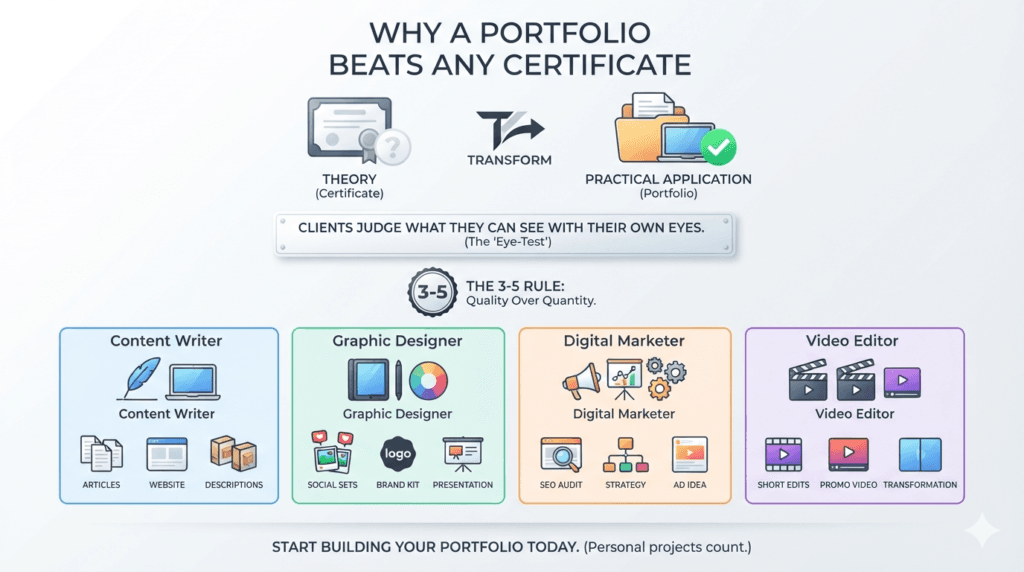
A certificate says you attended a class. A portfolio shows you can actually do the work — and clients can only judge what they can see with their own eyes. You don’t need dozens of samples. Three to five strong, specific ones do the job:
- Content writer: three SEO-focused articles, one set of website copy, a couple of product descriptions.
- Graphic designer: two or three social media sets, one brand identity sample, one presentation deck.
- Digital marketer: one SEO audit of a real (or local) site, one social strategy outline, one sample ad idea.
- Video editor: two or three short edits, one promo-style video, one before-and-after transformation clip.
None of this needs to be paid work yet. It just needs to make a stranger stop scrolling and actually read further.
A Realistic 90-Day Roadmap
Students delay starting because they think they need years of preparation first. You don’t. You need a plan.
Days 1-30: Pick one skill and learn it
Just fundamentals. Do not try to learn five things at once. That’s the fastest way to learn nothing well.
Days 31-60: Build your proof.
Make real-looking projects, even fake ones. A social media campaign for a Nepali restaurant. SEO articles for a made-up travel company. A sample website for a small business that doesn’t exist yet.
Days 61-90: Go find clients.
Set up profiles on Upwork, Fiverr, and LinkedIn. Look locally too- plenty of Nepali businesses need digital help and simply don’t know where to find someone. Your first gig won’t be your dream gig. That’s fine. The goal right now is experience, not glamour.
Meet Anisha, Who Took One Realistic Path
Anisha is a BBA student in Kathmandu. She started out trying to learn coding, design, and marketing all at the same time, a classic beginner mistake, and quickly realized she was spreading herself too thin. So she picked one thing: digital marketing. For the first two months, she studied SEO basics and social media strategy. But she didn’t just watch videos. She looked at real local businesses, how a restaurant nearby got customers, and how an education company promoted its courses online and studied what actually worked. Before she looked for a single client, she built proof: a sample social strategy, a basic SEO audit, a content calendar for a made-up brand. Zero income at this point. Just evidence.
Her first real client wasn’t glamorous. It was a small local business that needed help managing its online content. The pay was small. What she gained instead, handling client messages, hitting deadlines, understanding what a business actually wants turned out to matter more. Bigger opportunities came later, once she had something real to point to.
The lesson here isn’t the exact timeline in digital skills for freelancing in Nepal . It’s the order: learn, practice, build proof, find work, get better. Skip a step, and the whole thing gets harder than it needs to be.
Landing Your First Client (and Dodging the Scams Along the Way)
Your first client is the hardest one. Not because you lack skill because you lack trust, and trust takes time to build. Start small. Small projects build reviews faster than you’d expect.
Write a specific profile, not a vague one. “I help small businesses improve online visibility through SEO and content strategy” beats “I am a digital marketer” every single time. Specific beats fancy. Communication wins more jobs than raw talent does. Freelancers who ask clear questions, give regular updates, and hit deadlines get called back. A technically brilliant freelancer who goes quiet for a week loses that same client fast.
One more thing nobody tells beginners clearly enough: getting paid. PayPal doesn’t support receiving money in Nepal that surprises a lot of new freelancers. Most people here use Payoneer or Wise instead, then move the money into a local bank account. And yes, freelance income can carry tax responsibilities too, just like any other income. Worth a quick check with a tax professional once the money starts coming in steadily, rather than guessing later and getting a surprise.
Now, about the scams because they’re out there, and they target beginners specifically. Watch for: anyone asking you to pay a “registration fee” before work even starts. Pressure to move the conversation off the platform immediately, into some random chat app. Fake payment screenshots claiming money is “on the way” (it never arrives). Unpaid “test projects” that are just real client work in disguise. A real client pays through the platform’s actual system. They never ask you to pay them first. Ever.
Your Second Client Matters More Than Your First
Here’s a pattern I’ve watched play out over and over: the real income growth doesn’t come from client number five. It comes from client number one hiring you again, and telling a friend about you.
A repeat client costs you nothing to win back and usually pays better than a total stranger, simply because the trust is already there. So your job isn’t just finishing the project. It’s making that client’s life a little easier than they expected. Reply faster than they think you will. Deliver a day early when you can manage it.
None of that takes advanced skill. It takes reliability which, honestly, is rarer on freelance platforms than you’d guess. That’s exactly why it stands out so much.
Mistakes I See Nepali Students Make, Over and Over
Trying to learn five skills at once. Pick one. Master it. Then, and only then, add another.
Expecting fast money. Freelancing isn’t a lottery ticket. The early months build skill and reputation. Income shows up after that, not before.
Ignoring the business side of things. The freelancers who earn the most don’t just finish tasks, they understand the actual problem underneath the task. A writer isn’t just writing words. They’re helping a business get more customers.
Skills That Matter as Much as Your Technical Ability
Here’s something I wish someone had told me earlier in my own career, and something I keep telling students now: your technical skill gets you noticed. Your soft skills get you hired again.
Clear English communication. Honest time management. Staying calm under a tight deadline. Basic negotiation. Simply being someone a client wants to work with twice. None of that needs a course. It needs practice, on every project, even the boring small ones.
Where This Is All Heading
Nepal’s digital economy is still young, which is exactly why getting in early matters. More businesses move online every year. Remote work keeps becoming more normal, not less. Employers care more and more about actual remote work skills, sometimes even over a degree.
Tools will keep changing. Whatever software is popular today will probably look outdated in five years. What won’t change is the value of learning fast, communicating clearly, and adjusting when things shift under your feet. Build that muscle now, on whichever skill you pick first, and it carries you through every version of this economy that comes next.
Final Word: Start Small, Keep Showing Up
The biggest advantage students have today isn’t talent. It’s access to information, to tools, to clients halfway across the planet. That access means nothing until you actually act on it.
You don’t need to be an expert this month. You need to begin. Pick one online income skill. Practice it. Build real proof. Learn from whatever goes wrong along the way, because something will. Your first project might be small. Your first payment might not impress anyone. Every single freelancer who’s doing well today started exactly there, at the bottom, unsure if it would even work.
The future doesn’t belong only to people with the right degree. It belongs to people who can create value for someone else. Digital skills for freelancing in Nepal are simply the tool Nepali students have in their hands right now to do exactly that. The sooner you start, the sooner it starts working in your favor.
Turn Your Interest into Real-World Skills
If this guide has inspired you to explore freelancing, the next step is learning skills that businesses are actively looking for. A course in Digital Marketing in Nepal can help you master SEO, social media marketing, content creation, AI-powered marketing tools, Google Ads, and analytics while working on real projects that strengthen your portfolio.
Whether your goal is freelancing, landing your first job, or growing your own business, the right training can give you a solid foundation.
Explore our Advanced Digital Marketing Training in Nepal and start building the skills that shape successful digital careers.
FAQs
Which digital skill is easiest for Nepali students to start freelancing with?
Content writing, Digital marketing, SEO and graphic design tend to be the easiest starting points, since they need less technical background. Long-term growth still depends on going deeper over time, though.
Can students freelance while studying in Nepal?
Yes, plenty do. The key is managing your time honestly and picking projects that actually fit around your classes and exams.
How long does it take to become freelance-ready?
Most beginners need about three to six months of steady practice before they’re ready for entry-level client work.
How do Nepali freelancers receive international payments?
Most use Payoneer or Wise to receive money, then transfer it to a local bank account, since PayPal doesn’t support receiving payments in Nepal.
What are the biggest scam warning signs to watch for?
Upfront “registration fees,” pressure to move off-platform right away, unpaid “test projects,” and payment screenshots claiming money is coming instead of showing it’s actually arrived.
Is Fiverr or Upwork better for a Nepali beginner?
Fiverr rewards a strong, searchable gig listing and fast delivery. Upwork rewards detailed proposals and longer client relationships. Plenty of students end up using both.
Reviewed & Validated By:
Prajwal Karki – Digital Marketing Strategist and Trainer at UpSkills Nepal


