

The internet has been ranked as one of the applicable resources that connect people, their businesses, and societies across the globe. However, it also brings about the possibilities of various cybersecurity threats, in addition to bringing convenience and opportunities to the citizens.
Moreover, the rate of cybersecurity threats has also been high in countries like Nepal, and the cases of cybercrime in the last two years have also served 19,730 cases. The cybersecurity in Nepal has put the country at risk of cyberattack and bank failure. This paper has reported that Nepal needs to improve its digital security mechanisms in order to prevent future cyber attacks.
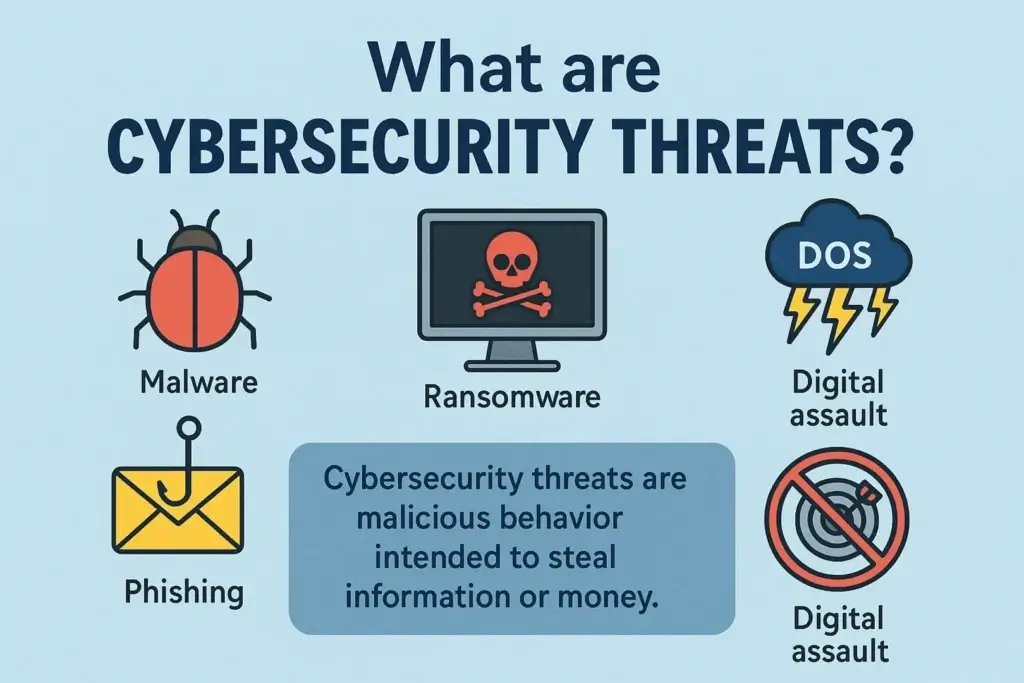
Understanding Cybersecurity Threats
We will discuss some of the best cybersecurity threats that you should be aware of and will give you some tips that you can use in this instance to save yourself and keep your privacy in this case.
DoS attack
When a DoS attack is in question, spurious traffic is directed to the target site. The replies consume the resources of the site, as the site has to respond to all the replies. This makes the site useless to the users since it is normally the case, and thus it normally results in a complete shutdown of the site. DoS attacks and DDoS attacks cannot be compared with other types of cyberattacks, during which the attacker can access a system and increase the access that he or she has already acquired.
Ransomware
In ransomware cybersecurity threats, the attacker keeps the system of the victim as a ransom until the victim pays the ransom. After posting the payment, the attacker subsequently provides instructions on what the target can do to get back control of his/her computer. The ransomware then encrypts the workstation of the target. In other cases, ransomware can consist of attacking multiple parties by shutting down the access of any number of computers or a central server that is so important to the business itself.
SQL injection attacks
It is a common practice to abuse sites based on databases to offer services to their customers. The clients are computers where the information is passed to the servers, and an SQL attack makes use of a single SQL query whereby the client transmits the query to a database located on the server. The command is injected or inserted into a data plane rather than some other thing that would be otherwise injected, such as a password or a login.
URL interpretation
In URL interpretation, the attackers alter and build the URL addresses of some URLs and use them to obtain personal and professional data of the target. This kind of attack is also referred to as URL poisoning. The name of interpretation of the URL lies in the knowledge of the attacker, which is that the URL information in a web page depicts a sequence to be typed in. The attacker then deciphers this syntax, which is later used to establish the mechanism of gaining access to fields a person has no right to.
DNS spoofing
In Domain Name System spoofing, the hacker alters the DNS records in order to divert the traffic to a rogue or spoofed site. Once the victim’s access has been obtained to the fraud site, the victim is most likely to give sensitive information, which can be utilized or sold to the hacker. In a DNS spoofing attack, the attacker takes advantage of the fact that the user is under the impression that the site he/she is accessing is authentic. This enables cybersecurity threats to commit a crime on behalf of a crime-innocent company, at least to the investigator of the visitor.
Phishing attack
The attack is executed when an attacker sends you a link directing you to a website that defrauds you into downloading malware, such as a virus, or gives the attacker your personal information. These are a combination of social engineering and technology, and so-called in that the attacker is, in actuality, fishing for access to a forbidden zone by taking the bait of a seemingly legitimate receiver.
Malware attack
Malware is the term used to refer to malicious software in general; thus, malware gets into a computer and changes the functionality of a computer or wipes the data, or even spies on the actions of a user or network traffic moving through. Malware can either be transferred to other computers, or it can remain in a single location, though it can only have an impact on the host computer. Moreover, other forms of attacks can involve malware attacks, which include MITM attacks, phishing, ransomware, SQL injection, Trojan horse, drive-by attacks, and XSS attacks.
Cybersecurity in Nepal
The threat to cybersecurity in Nepal is growing in the case of a country like Nepal, where the digitization of government services is on the rise, and the use of e-commerce is on the rise. The cybersecurity threats breakthrough in Nepal started with the attack of a group of hackers on 58 different government websites through a group known as the Paradox Cyber Ghost. Due to the increasing number of cybercrimes, increasing levels of data and information security in Nepal are greatly appreciated in order to store certain personal and confidential information. Nepal is 94th in the world with respect to cybersecurity threats. These remain the most critical steps that should be taken to prevent different types of cybersecurity threats.
- Using a unique password
They should be composed of complex passwords, and an effective password management tool should be employed.
- Multi-factor authentication anywhere can be enhanced.
This will offer a second factor, which will be vital even in the event that a hacker takes away your password, and still, they cannot access your account without the second factor.
- Install the current software and operating systems.
Enable automatic updates, which typically are fixes to any critical security vulnerabilities that can be exploited by malicious hackers.
- Become a skeptic, master phishing detection
Never click on links or download attachments, and verify requests for sensitive info or money transfer.
- Maintain security software
Use a trusted antivirus on all your devices and ensure it is updated to run.
- Back up your data regularly
At least keep three copies of your data, which can become an ultimate defense against ransomware.
- Secure your network
Use strong encryption for your wireless network, and change the default password on your home WIFI router.
- Practicing the principle of least privilege
Remember to give only access to the data and systems necessary for their role if the device is shared at work.
Learn the skills to spot, stop, and respond to today’s cyber threats. Join Nepal’s top Cybersecurity Course and start building a secure and successful career.
Cyber threats are increasing every day, and staying safe online has become a basic need for all of us. By using strong passwords, turning on two-factor authentication, keeping your apps updated, and being careful with suspicious links, you can avoid most common attacks. A little awareness goes a long way. Stay alert, stay updated, and protect your digital life before it’s too late.
FAQs on Top Cybersecurity Threats and How to Stay Safe Online
What does a DoS attack do?
It floods sites with junk to crash them. Users can’t load pages.
Why is Nepal open to cybersecurity threats?
Fast online growth meets weak guards. Training and tools lag.
Why back up data?
Restore files if ransomware locks them. No pay to crooks.
What is Nepal’s cyber safety level?
It grows slowly. Ranks 94th worldwide. Needs a big push.
Top three personal tips?
Back up data. Lock network. Use two-step login.


